






6 min read
Using firm playbooks to make clause review more focused and explainable
By Rahul Makwana, AI Engineer
Short answer: An AI redline for an engagement letter should show the exact clause, the firm
playbook rule it was compared against, a proposed edit, and the reasoning that connects them. The
reviewer then accepts or rejects it. The model handles the comparison, and the reviewer keeps the
judgment about what the client engagement actually requires.
Consider an accountant reviewing an engagement letter after a client has revised its scope
language. One sentence now appears to include an additional service. The reviewer needs to
compare that wording with the intended engagement and the firm's approved guidance, then decide
whether to revise it or seek clarification.
At HubSync, I worked on an AI-guided redlining approach for the Engagement Letter Wizard to
support this kind of review. The first-phase design brings together a clause, the relevant firm
playbook rule and a proposed edit, with an explanation of the connection. The accountant can
inspect the suggestion and decide what to do with it.
The intended benefit is a more focused first pass through the letter: less effort locating the applicable
guidance and assembling a comparison, with the original text and proposed change available for
review. The approach depends on a clear division between the model's comparison work and the
reviewer's judgment about the engagement.
The four practices below explain how that division works in the first-phase design, followed by how
to evaluate whether it helps reviewers.
Key takeaways
-
A useful AI redline starts from the specific review decision it should help the accountant resolve.
-
AI redlining should route clauses to the relevant playbook rules, and flag a clause for review when no rule applies.
-
Every AI suggestion should stay tied to the exact passage and document revision it compared.
-
The reviewer should see the original wording, proposed edit, rationale, and rule citation, and the decision and the edit stay with the reviewer.
-
AI redlining should be evaluated by whether it helps an accountant make a sound decision, not by how many suggestions it produces.
1. What should an AI redline help the reviewer decide?
A useful suggestion needs to help the accountant resolve a specific question about the
letter. Merely rewriting a paragraph in smoother language may add review work without addressing
that question.
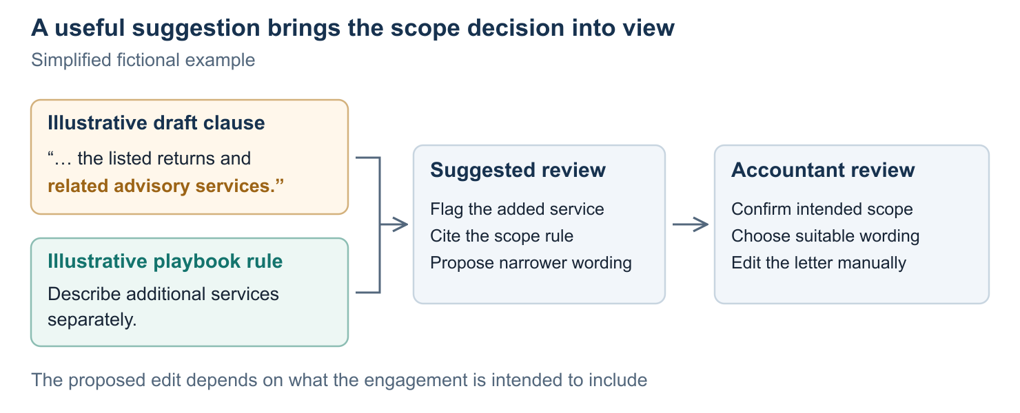
In a simplified fictional example, a draft says, “Our services include the preparation of the listed
returns and related advisory services.” Suppose the applicable playbook rule says that additional
services must be described separately. The phrase “related advisory services” becomes the point to
examine.
The system could flag the phrase, cite the rule and suggest wording that limits the clause to the
listed services. The reviewer would still need to establish whether advisory work was actually
intended. If it was, the right response might be to describe that work explicitly. If it was not,
narrowing the wording might be appropriate.
The value of the suggestion lies in placing that decision in front of the reviewer with its basis visible.
The model cannot infer the full agreement with the client from one sentence. A confident proposed
edit should remain open to rejection when it conflicts with the engagement's context.
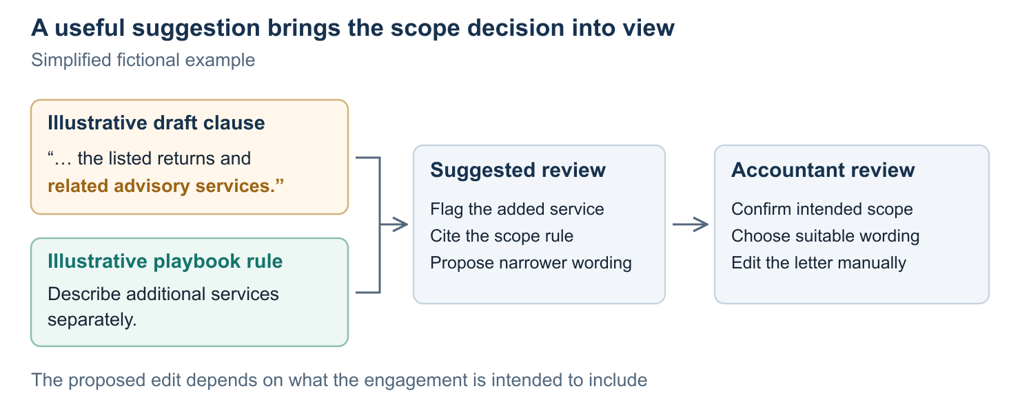
Figure 1. A fictional example of a playbook-backed review. The clause and rule are simplified illustrations, not customer text or approved firm guidance. The diagram shows a review decision, not a product screenshot.
2. How should a firm playbook be prepared for AI comparison?
The playbook provides the basis against which the clause is assessed. Its rules need enough
structure to identify what they apply to and enough source context for a reviewer to understand why a suggestion was made.
Our design routed clauses to relevant candidate rules before asking the model to compare them. A
clause about the services being provided should reach rules that govern that subject. Sending every rule with every clause would leave more of that selection work to the model and make an unrelated recommendation harder to diagnose.
Selecting candidates also creates a dependency: the comparison can only use the guidance it
receives. The preparation step therefore needs its own checks, including what happens when the
clause cannot be classified or no relevant rule is available. In that situation, flagging the clause for
review is more useful than presenting unsupported wording as a playbook-backed recommendation.
For development, we used an interim starter playbook. Its contents still needed subject-matter
confirmation. A working comparison pipeline does not establish that its reference material expresses a firm's approved position. Bringing this approach into a firm's workflow would require the appropriate specialists to validate the rules and their applicability.
That work has a direct effect on the accountant's experience. A precise rule can produce a focused
comparison. A vague rule may produce suggestions that require the reviewer to reconstruct the
missing context each time.
3. How does each AI suggestion stay tied to the letter?
In this design, each suggestion keeps its link to the exact passage, its location in the letter,
and the document revision it compared. The technical work begins before the model sees a
clause. The editor's stored document must be converted into a consistent representation of text and
structure. Clause detection then identifies passages for comparison while preserving their locations
in the letter.
That location matters because the output is meant to support editing. The reviewer should be able to
inspect the exact passage that prompted a suggestion, including enough surrounding context to
judge it. A detached summary can omit a qualification in the next sentence or make a suggestion
difficult to locate.
The design also has to account for existing tracked changes. Inserted and deleted text can affect
which wording is treated as current. Those choices need to be explicit during preparation so the
comparison and the reviewer are looking at the same version of the passage.
Once the model returns a result, the system validates its structure and retains its connection to the
source text and document revision. If the letter changes during review, an older suggestion may no
longer fit. Recognizing that mismatch helps prevent the reviewer from acting on a comparison of
wording that has already been revised.
These details support a simple expectation from the accountant's perspective: the suggestion should
refer to the text currently under consideration, and its cited rule should be available to inspect.
4. What should the reviewer see in each AI suggestion?
In the Phase 1 design, a suggestion includes the original clause, proposed text, a rationale and a rule citation, along with a confidence indicator. Each element serves a different purpose:
-
The original and proposed wording make the change visible.
-
The rationale identifies the model's interpretation.
-
The citation lets the reviewer check the actual guidance.
-
Confidence can inform attention, but it cannot establish that the recommendation fits the engagement.
The reviewer can accept or reject a suggestion, with editing of the letter remaining manual in this phase. Applying suggestions directly to the document was deferred until accounting subject-matter experts had evaluated their quality. This gives the team a way to assess the comparison work before increasing the system's authority to change a letter.
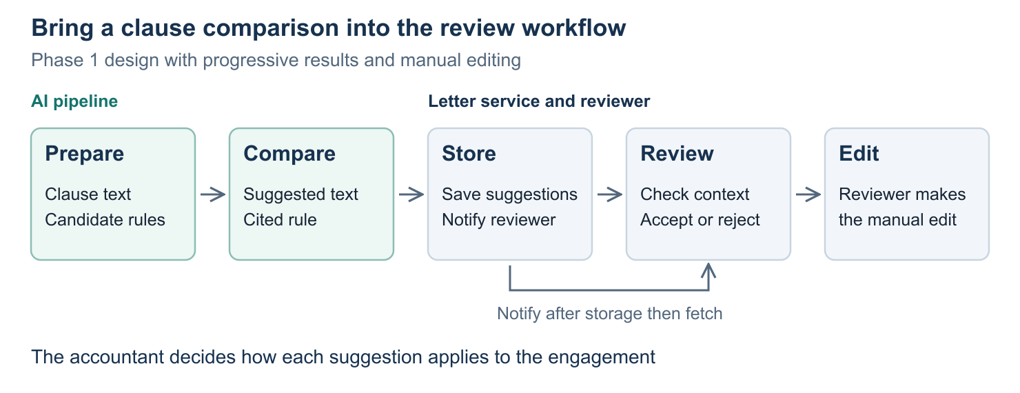
Figure 2. The Phase 1 review design. Suggestions support the accountant's decision, and changes to the letter remain manual.
The architecture reflects that division of responsibility. The AI pipeline performs the comparison and returns suggestions. The letter service owns the stored results and review decisions, as well as changes to the document.
Results were designed to arrive progressively so a reviewer could begin examining available suggestions while comparison continued. The service would store each batch before notifying the browser, allowing the review panel to fetch the saved results. A sequence attached to the run would support recovery after a reconnect without relying on a notification to be the only copy of a suggestion.
For the reviewer, the purpose is continuity: a partial review should be recoverable, and the suggestions already received should remain associated with the letter being reviewed.
How should a firm evaluate AI redlining?
The useful measure is whether the comparison helps an accountant make a sound decision with less avoidable preparation. Counting generated suggestions would not answer that question. A system that flags every unusual phrase could create more work than it removes.
Evaluation needs representative letters and reviewers who understand the firm's expectations. Those reviewers should be able to assess whether a suggestion:
-
Identifies a meaningful deviation from the playbook.
-
Cites a rule that applies to the clause.
-
Proposes wording that preserves the intended engagement.
Clauses that are already acceptable belong in that evaluation too, so the team can see whether the system introduces unnecessary edits.
The development work began with synthetic examples and a proposed quality evaluation. Review of representative letters would help establish which suggestions are useful, where more context is needed and whether the comparison reduces preparation effort.
A well-designed review item would let the accountant move directly from the relevant passage to the applicable guidance and a specific proposed change. That is the unit of help worth testing before expanding the workflow: one clause, presented with enough context to support the next decision.
HubSync is an all-in-one AI operating system offering end-to-end tax and accounting workflow platforms, built exclusively for leading CPA firms. The redlining design described here was built for HubSync's Engagement Letter Wizard, which firms use to create, route, e-sign, and track engagement letters. The same division of work, where AI prepares the comparison and a person makes the call, informs how we build agent workflows in HubSync Halo, the central AI orchestration engine behind HubSync's AI agents.
When isn't AI redlining the right fit?
AI redlining depends on an approved basis for comparison, so it is a poor fit when a firm has no written engagement letter playbook, or when its rules have not been validated by the people who own them. In that case, redlines can look authoritative without an approved position behind them, and documenting the playbook is the better first project. For individually negotiated clauses, the comparison should surface the relevant guidance and leave room for an authorized exception.
Frequently asked questions
Can AI redlining replace an engagement letter reviewer?
No. AI redlining handles the comparison work: finding the clause, matching it to the relevant playbook rule, and proposing an edit with its reasoning. The reviewer still decides whether the suggestion fits the engagement, because a model cannot infer the full agreement with a client from a single sentence.
What should happen when no playbook rule applies to a clause?
The system should flag the clause for review rather than produce an unsupported playbook-based edit. The reviewer can then determine whether the clause is outside the playbook's scope, a relevant rule was missed, or additional guidance is needed.
Should AI apply redline suggestions directly to the letter?
Not at first. In the first-phase design, the reviewer accepts or rejects each suggestion and edits the letter manually. Applying suggestions directly is deferred until accounting subject-matter experts have evaluated their quality on representative letters.
About the author
Rahul Makwana builds AI agent workflows at HubSync. His decade of engineering experience spans enterprise software, connected devices and AI tools for audit review. He also mentors engineers and students in practical AI development.